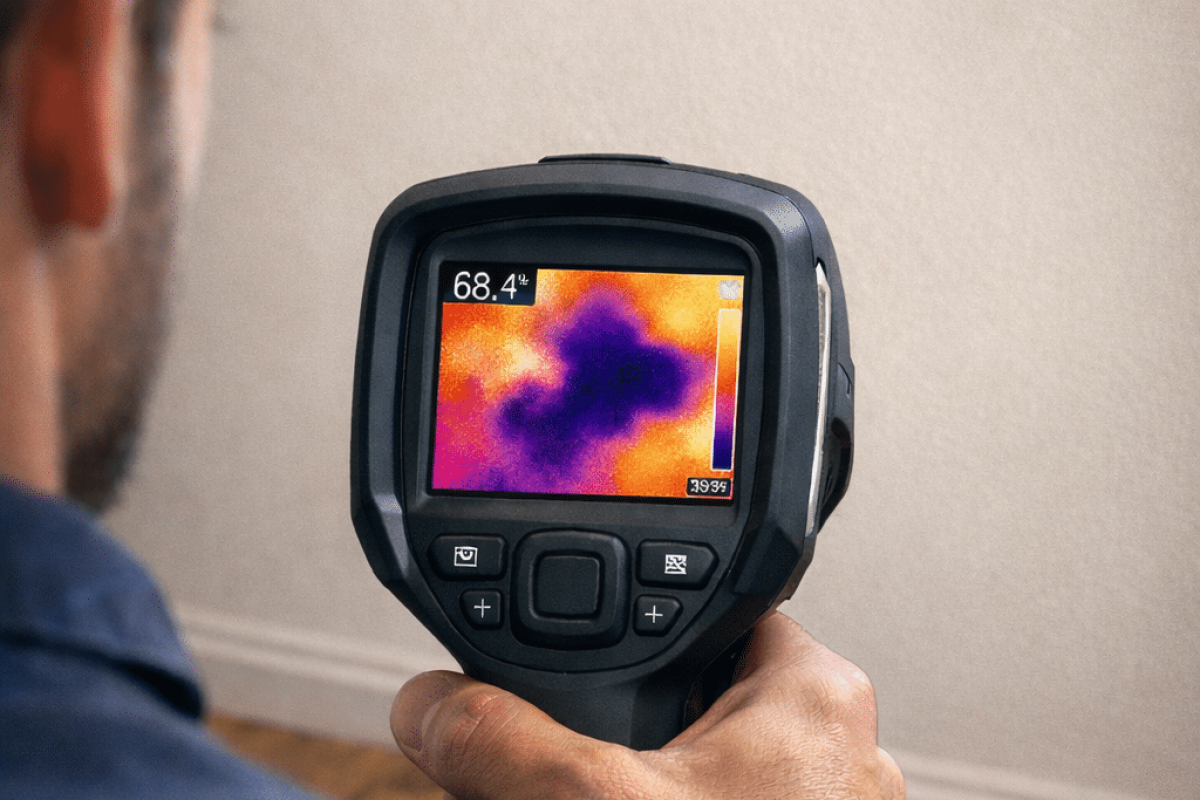
A moisture meter gives you a number. A thermal imaging camera gives you a picture.
For years, restoration professionals relied on moisture meters and experience to locate water intrusion. While meters are accurate, they are not always visually convincing to a homeowner or a desk adjuster reviewing a file.
Enter the Thermal Imaging Camera (TIC).
What the adjuster actually sees
One of the biggest challenges in water mitigation is demonstrating that a ceiling or wall that “looks dry” is actually wet, or revealing water migration pathways across ceilings and framing members.
When a homeowner sees a distinct blue or purple thermal anomaly across their ceiling, skepticism disappears. You stop looking like a contractor “pushing demo” and start looking like a professional explaining risk and damage conditions.
It is a guide, not a guarantee
Thermal imaging cameras do not detect moisture. They detect differences in surface temperature. Evaporative cooling often makes wet materials appear cooler, but other conditions can create similar images, including:
- cold air from HVAC ducts
- missing insulation
- temperature bridging through framing
Do not tear out a wall based only on a thermal image.
The correct approach is to use the TIC as a locating tool. Identify the anomaly with thermal imaging, then verify it with a moisture meter before determining the scope of work. (See: Surface Dry vs. Structurally Dry)
The documentation advantage
The strongest documentation package pairs:
- a thermal image showing the affected pattern, and
- a moisture meter reading from the exact same location
This creates a highly defensible scope of work. (See: The Golden Rule of Claims)
Example: “Reason for 4 ft flood cut: Thermal imaging identified moisture at approximately 3.5 ft, verified by invasive moisture meter readings.”
Beyond water mitigation
Thermal imaging is also valuable for:
- Identifying missing insulation during rebuilds
- Documenting heat signatures on overloaded electrical circuits
- Locating potential energy loss areas
It is a versatile diagnostic and documentation tool that pays for itself every time it prevents a dispute, a callback, or a missed water damage area.
The camera finds it. The meter proves it. The photo defends it.