The desk adjuster approving your invoice has never set foot on the property.
“Paint a picture for the adjuster” is a restoration cliché for a reason. In modern claims handling, the person approving your invoice is almost always a desk adjuster who never sets foot on the property. They rely entirely on the evidence you submit. If a line item lacks clear photographic support, strict carrier guidelines often instruct them to remove it.
The goal of documentation is not simply to show that damage exists. It is to clearly prove that the work you performed was necessary, reasonable, and connected to the loss.
Context is king
An extreme close-up of a water stain or swollen baseboard is useless without room identification and scale. To eliminate confusion and reduce back-and-forth questions, use the Macro-to-Micro approach for every affected room.
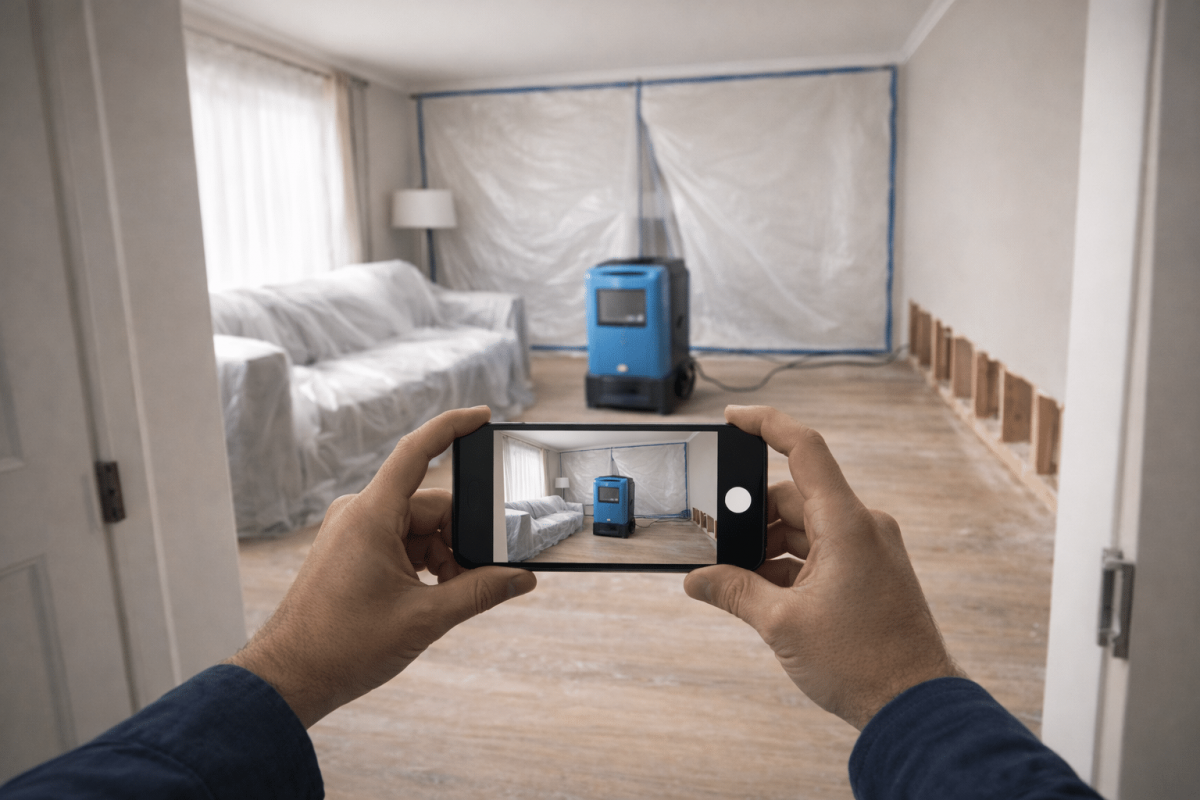
Room Shot (Macro) Take a full-room photo from the doorway. This establishes layout, flooring type, finish quality, and contents density. It also demonstrates the difficulty of the work and the site conditions.
Damage Context Step in and capture the affected area in relation to the room. Show the migration path from the source to the impact area. This connects the cause of loss to the repair scope.
Specific Damage (Micro) Now take the close-up of the swollen trim, delaminated carpet, soot webs, or staining. When the adjuster understands what they are looking at, approval resistance drops significantly.
Documenting invisible work
Some of the most expensive parts of a job are not always immediately visible. To defend them, you must make the invisible visible.
- Photograph meter readouts beside dehumidifiers to prove grain depression. (See: Surface Dry vs. Structurally Dry)
- Show stacked boxes in the garage to demonstrate the volume of contents and the effort required to handle them.
- Capture containment barriers, zipper walls, and technician PPE before they are removed. (See: Why Bleach Is a Bad Word in Restoration)
These images help justify labor, safety & environmental controls, as well as equipment runtime.
Defending against pre-existing conditions
Photos protect your company as well. Notice a cracked granite countertop, dented refrigerator, or stained carpet before work begins? Document it immediately. Without that initial photo, the homeowner may later claim your crew caused it.
This is where 360° scanning tools pay for themselves. Every surface is documented before anything is touched. (See: The End of “He Said, She Said”)
Treat your photo package like court evidence, not a snapshot album. When your documentation tells a clear visual story, you see fewer reductions, fewer arguments, and faster payments.
Every photo you skip is a line item at risk.